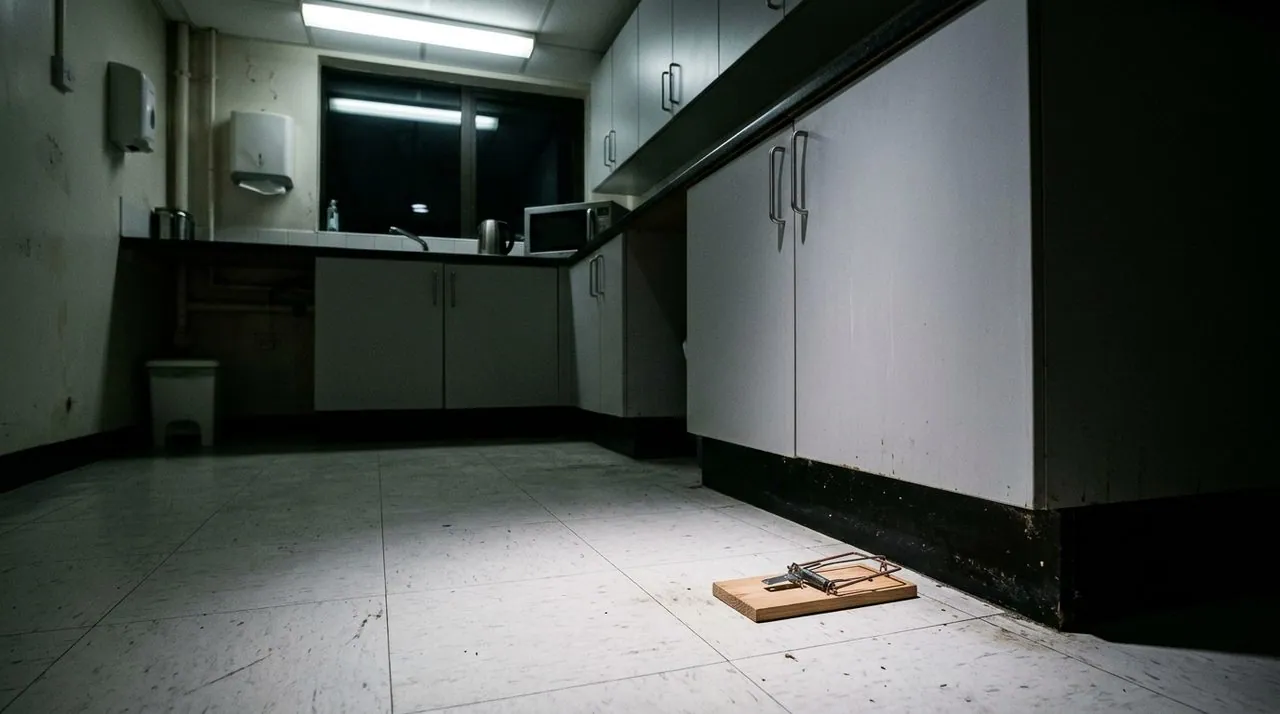
HALIFAX — A Halifax man says he witnessed mice scurrying around the emergency department at the QEII Health Sciences Centre and climbing on a patient's bed. Jordan Bonaparte was at the Halifax Infirmary emergency room with a family member on Saturday. He said he saw mice in the halls for nearly six hours before his relative was moved to a room. Within minutes, Bonaparte said a mouse emerged and began climbing on the bed. "I'm pretty sure if I didn't get up and stomp my feet, that thing was going right up on my bed to get up where the food was that they were serving her," he said.
Nova Scotia Health acknowledges the rodent issue at the QEII complex is beyond what is expected in a port city. Documents obtained by CBC News show the health authority's pest control bills at the QEII and Dartmouth General Hospital have soared over the last five years. The QEII's budget jumped from $35,942 to $323,075, an increase of 798 percent. Dartmouth General saw the biggest percentage increase in the province, going from $9,545 to $120,012 last year, a rise of 1,157 percent. "The volume of those sightings has increased exponentially over the last couple of years," said Chris Smith, the senior director for facilities operations at Nova Scotia Health. He said the health authority is doing whatever it can to keep rodents out of healthcare settings. "It's easy to say that we live in a port city and it's a thing, but it doesn't change our opinion and approaches that they don't belong in health-care settings and we've got to do whatever we can to keep them out and keep those environments clean, sanitary and safe," Smith said.
Both hospital sites are surrounded by extensive construction projects. Smith said breaking ground on the QEII expansion project was expected to stir up pests. "We did expect an increase, but I don't think we expected quite the increase that we're seeing," he said. In the last five years, the health authority has caught 1,435 mice or other rodents in the QEII buildings, which cover 2.9 million square feet. A further 321 rodents have been nabbed at the Dartmouth General Hospital.
Smith described the environment as complex, with aging buildings and thousands of people going in and out daily. He said the problem is years in the making and will likely take several years to fully control. His department has a three-pronged approach, hiring professional exterminators who visit daily, asking staff to report sightings, and conducting external inspections to find and seal entry points. "Some of that effort resulted in 100 or 200 work orders for all of these little cracks and crevices that needed to be closed up," Smith explained. "If there's any that are still open, we're actively working on them. It's not an overnight fix."
Meanwhile, the IWK Health Centre said mice are not its biggest issue despite being next door to the QEII. The women and children's hospital spent $180,000 last year after discovering "unusual bird activity," largely an issue with pigeons. In a statement, the IWK said the work included extensive cleanup of bird droppings and nesting areas, as well as applying netting and spiking to deter birds. The hospital said it expects to monitor the issue for a while, meaning some costs will be ongoing.
Bonaparte posted a video of his experience to his podcast pages called The Canadian Gothic. He said the response included several comments from people saying such sightings are normal. "If your bar for health care is set so low that you're accepting there to be mice running around the emergency room where people are clinging to life, I think that's an unreasonably low expectation to have," Bonaparte said. Smith is asking staff and patients to keep an eye out and report all sightings.