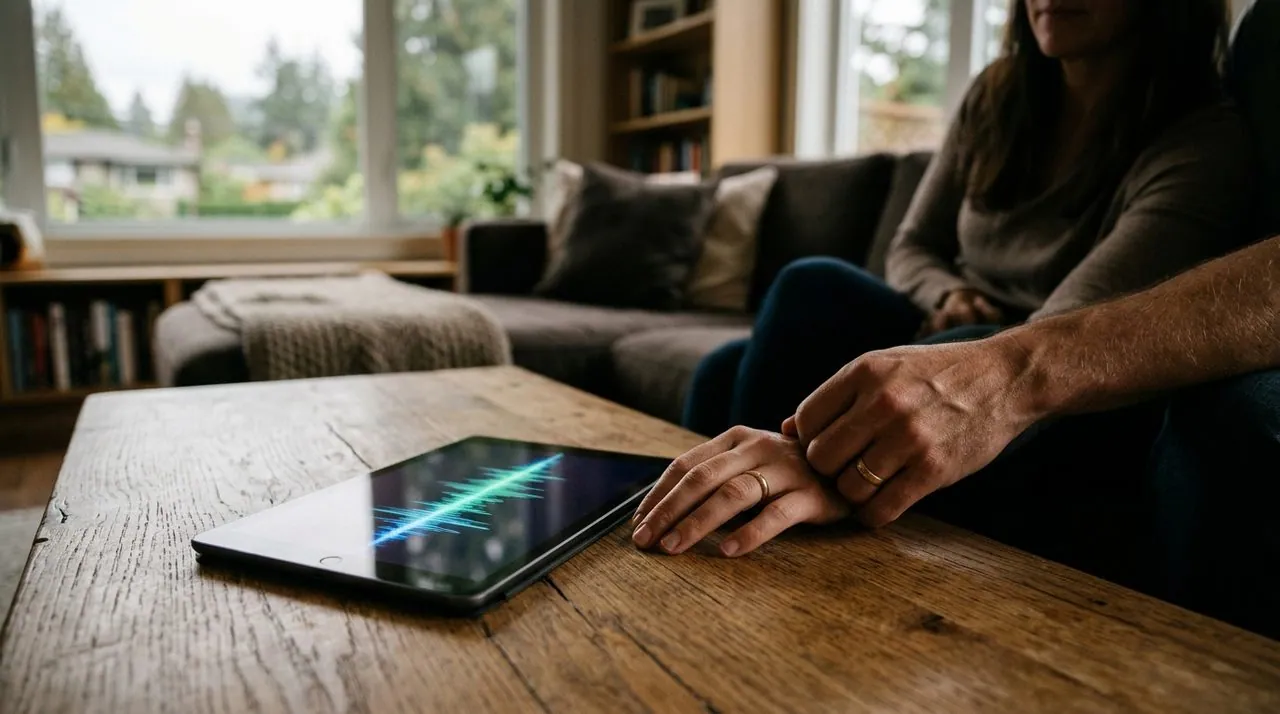
MONTREAL — Anne-Marie Poirier can speak with her nieces and nephews again using a new artificial intelligence tool that creates a simulated version of her voice. Poirier has amyotrophic lateral sclerosis, a progressive neurological disease that took away her ability to speak. The Montreal-developed application, called Vocality, allows her to turn a few keywords into complete sentences spoken aloud in a voice that sounds like her own. "They are so happy. It's as though they forget that my life is slowly coming to an end," Poirier said using the AI tool. She began losing her voice in October 2025 and started using Vocality in May.
Vocality was founded in 2023 by Thomas Houlachi and David Ruiz, students at Polytechnique Montréal and Concordia University respectively. Houlachi was inspired after two family members were diagnosed with ALS and lost their ability to speak. He saw their frustration with slow, letter-by-letter typing on communication apps. "Speech is something so fundamental to the human experience. If you lose it, you lose half of that experience," Houlachi said. After more than two years of development and testing with people living with ALS, Vocality launched on iPhones and iPads in June, with an Android version expected soon.
The app uses AI designed for people with speech impairments, learning their vocabulary and expressions over time. Instead of typing full sentences, users enter keywords and the app fills in the rest. It can also listen to conversations and suggest responses. Some AI processing happens directly on users' devices to reduce sending personal information to external servers. Vocality is compatible with eye-tracking equipment for those with limited mobility. More than 100 people across North America now use the application daily, according to Houlachi.
A key feature allows users to communicate using a digital recreation of their own voice. Technology from AI company ElevenLabs creates a synthetic voice from recordings of the user's speech. For Poirier, the voice combines her actual recordings with digitally generated words. "It's so much simpler, more intuitive," she said. "The application allows you to correct mistakes, and with just a few words, it generates sentences." Poirier learned about Vocality through ALS Québec, a non-profit that helped recruit testers and offers financial assistance for eligible users.
Houlachi acknowledged public concerns about AI in health care but said his firm works with experts to ensure safe and ethical use. "We often talk about AI replacing what humans do, but Vocality is the exact opposite," he said. "It's a tool that gives people control, allowing them to continue expressing themselves authentically, while helping them communicate faster and more smoothly." Poirier has provided regular feedback to improve the app, such as a feature to save frequently used phrases and repeat sentences.
Paul Shenouda, a partnerships manager at Propolys, Polytechnique Montréal's technology incubator, said the founders' focus on involving patients early stood out. "It's rather rare to have a story that's so sincere," Shenouda said. Vocality has received business training, coaching and $16,000 in support from Propolys. Houlachi said the firm also raised an additional $150,000 through fundraising and prize money from contests. The app is now available in six languages and is being used by people with other conditions like cerebral palsy and some forms of aphasia.
For Poirier, the technology has opened unexpected possibilities, like communicating with her partner in Italian. Although she understands the language, she doesn't normally speak it. Vocality lets her generate sentences in Italian to be read aloud. "It gives me energy, a feeling of being alive," she said. Nearly 4,000 Canadians live with ALS, and about 1,000 are diagnosed each year, according to the ALS Society of Canada. Poirier says she wants to make the most of her time. "No one can guarantee they will live a long time," she said. "You have to enjoy every moment of life and be as happy as possible."