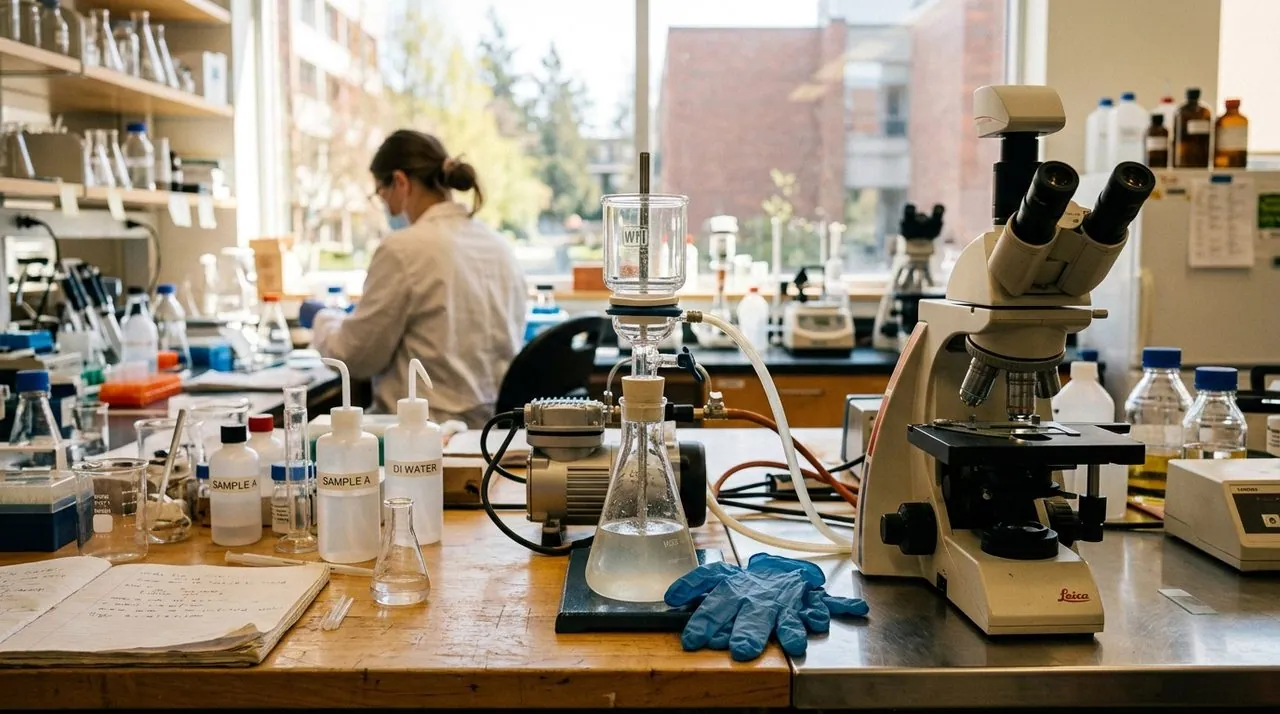
Nathalie Tufenkji, a professor at McGill University, has received the 2026 Prix Marie-Victorin, one of Quebec's highest scientific honours. The award recognizes her research on plastic pollution, water treatment and environmental health. Tufenkji holds the Canada Research Chair in Biocolloids and Surfaces and studies the movement and risks of tiny particles in water. The prize is part of the annual Prix du Québec awards from the provincial government. Another McGill researcher, pediatric brain cancer expert Nada Jabado, received the Prix Wilder-Penfield this year.
Dominique Bérubé, McGill's vice-president of research and innovation, praised Tufenkji's international impact. "Professor Tufenkji's internationally recognized research has expanded the frontiers of environmental engineering while helping to tackle critical challenges, including the global crisis of plastic pollution in soils and freshwater," Bérubé said. The vice-president added that her work and mentorship have strengthened Quebec's research leadership. Bérubé said the university is grateful to the government for recognizing researchers who help shape a better future.
Tufenkji's research has been cited over 30,000 times and featured in more than 80 global policy documents, including reports from the United Nations. Her studies on microplastics in bottled water and from plastic tea bags have drawn significant media attention. She said her earlier work on nanomaterials provided a natural entry into plastic pollution research. "I wanted to understand how they behave, where they're coming from, where they're ending up in the environment, and what the potential impacts are," Tufenkji said.
Her interest in science began in childhood with books about pioneers like Marie Curie. A fellow karate student who was a chemical engineer suggested she study chemical engineering near the end of CEGEP. She followed his advice and he later presented her with the Iron Ring at her McGill graduation in 1999. Her graduate research focused on how microorganisms and inorganic particles behave and are removed from water.
Beyond microplastics, Tufenkji's lab has created new water treatment methods using recycled-cellulose materials to trap contaminants. That project earned the Honoris Genius Award for Sustainable Development from Quebec's engineering order. Her team has also investigated cranberry and maple syrup compounds that can weaken bacteria and help fight antibiotic resistance. She said the common goal across her projects is to work on problems with real-world significance.
Tufenkji has guided more than 200 researchers at McGill, with many now working in academia, government and industry. She emphasized that research success depends on collaboration with motivated colleagues. "Research is teamwork," she said. "It takes a lot of different people, coming from different areas of expertise, working together to answer complex questions." She said great ideas need brilliant, committed people to become reality.
Her group is now focusing on even smaller nanoplastics, which are harder to detect than microplastics. They are also creating technologies to remove plastic particles from drinking water sources and wastewater. Tufenkji believes the broader aim of her work is to provide knowledge and tools to address environmental challenges. "We share this one planet, and we all have to work together toward making it better," she said. Other 2026 award winners with McGill ties include alumnae Julie Desrosiers and Marie-Josée Lacroix, and former postdoctoral fellow Mathieu Lapointe.