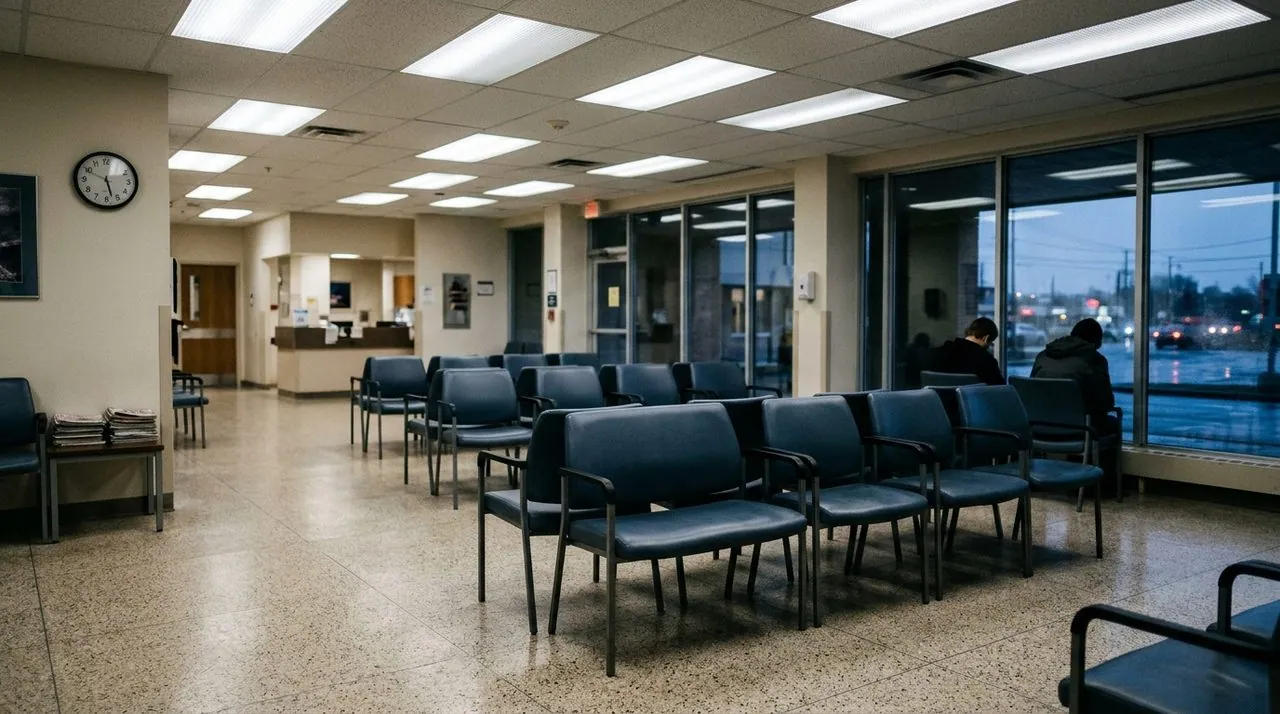
RED DEER — The median wait time in the emergency department at Red Deer Regional Hospital Centre was seven hours and 33 minutes last year, ranking as the fifth longest among Alberta's 100 hospitals. That figure represents an increase of up to 33 minutes compared to the previous year, according to a new report from the Montreal Economic Institute. The report measured the median length of stay from registration to discharge or admission to another department. Half of patients at the Red Deer hospital stayed longer than seven hours and 33 minutes, while half had shorter waits.
Patients there also faced a median wait of three hours for an initial assessment by a physician, the 12th longest such wait in the province. Across Alberta, the typical patient who visited an emergency room last year spent four hours there. Nationally, median wait times range from two hours and 47 minutes in Newfoundland and Labrador to five hours and 12 minutes in Quebec. Gerard Lucyshyn, the report's author and vice president of MEI research, said the situation has worsened over the past five years. "Despite the $15 billion added to provincial healthcare budget since 2020, Albertans now wait 36 minutes longer to see a doctor in an emergency room than they did five years ago," Lucyshyn said in a statement. "All this money has not translated into faster care, a clear sign that our healthcare system is not functioning properly." The report attributes part of the problem to emergency rooms becoming the default choice for patients who cannot access timely primary care, leading to overcrowding.
Another report from the Canadian Institute for Health Information showed provincial spending on health care administration has increased from $274 million per year in 2022 to a projected $489 million in 2026. Sandra Azocar, president of the Alberta Union of Provincial Employees, criticized the government's priorities. "Albertans are spending more money on worse health care. The provincial government is wasting hundreds of millions on bureaucratic, administrative changes instead of front-line services," Azocar said in a statement.
Azocar said emergency rooms are routinely closed due to staff shortages, especially in rural communities. "Breaking up AHS and privatizing services has only made it worse," she added. Chris Gallaway, executive director of Friends of Medicare, said the government has focused on reorganization rather than addressing capacity and workforce issues. He noted that the cancelled South Edmonton hospital project would have opened this year, and the Red Deer hospital expansion is the only major capital project to move forward in years.
"We are the lowest in the country for health care infrastructure spending, yet our administration spending is set to double," Gallaway said. He argued the government should focus on keeping people out of emergency departments and clearing hospital backlogs. "We're seeing their push to restructure, their push to a two-tier health care system which isn't going to help when there's an emergency and people need an emergency room," Gallaway said. The MEI, which supports two-tier health care, pointed to Alberta's new dual practice model allowing doctors to work in both public and private systems as a way to expand access. In response, Maddison McKee, press secretary for Hospital and Surgical Health Services Minister Adriana LaGrange, said emergency department pressures are a nationwide issue driven by population growth and complex patient needs. "While these challenges are not unique to Alberta, our government is taking action to strengthen emergency care and improve access for patients," McKee said in a statement.
McKee said Alberta has reached a record 9,000 acute care beds and is driving six major hospital projects that will add 1,000 beds, including the $1.8-billion Red Deer Hospital redevelopment. She also noted the recent announcement of nine new urgent care centres, including one in Sylvan Lake, which she said will increase provincial urgent care capacity by 150 percent. Citing CIHI data, she added that Alberta's overall health spending is in line with the Canadian average and exceeds Ontario and Quebec, with the province leading in physician and nursing workforce growth. "Alberta's government is making significant investments in health care, and focusing on individual spending categories without providing the broader context gives Albertans a misleading picture of what's happening across our health system," McKee said.