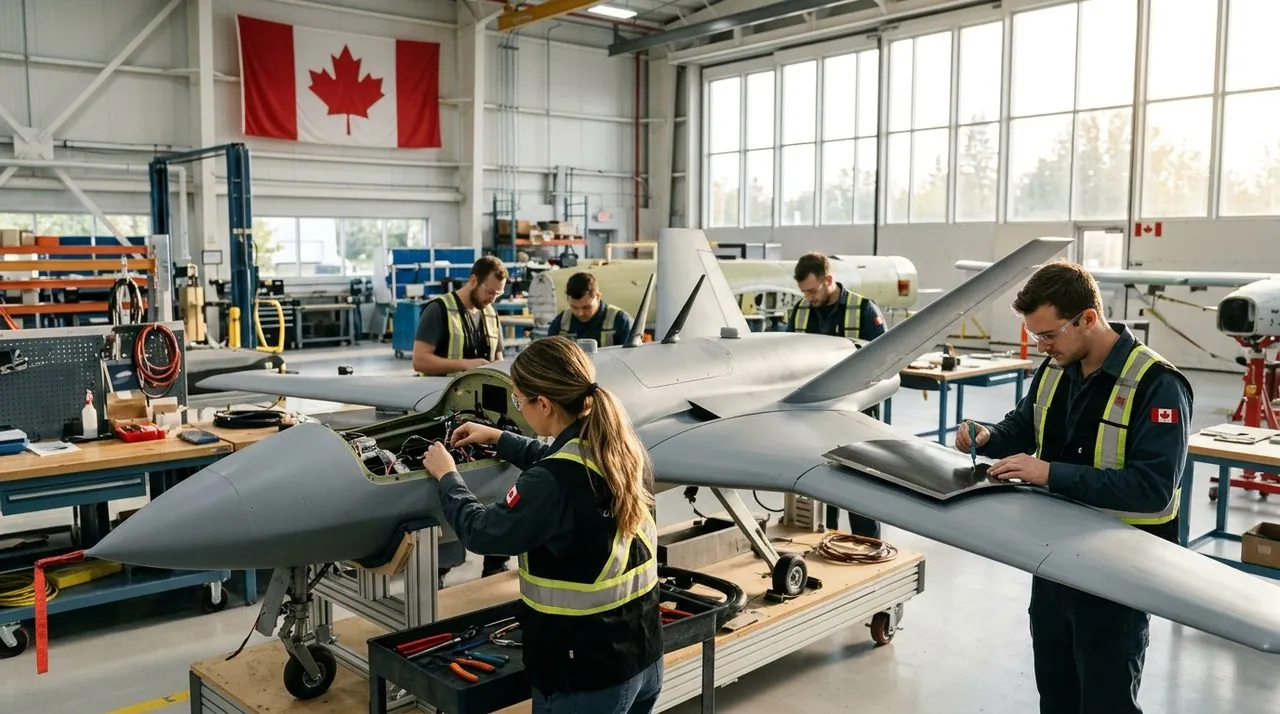
OTTAWA — Dominion Dynamics has brought together a consortium of a dozen Canadian companies to support the production of its uncrewed combat aircraft, betting on the federal government becoming its first customer. Each of the 12 companies has signed a memorandum of understanding or supplier agreement with the Ottawa-based defence tech firm in recent months. They will contribute capabilities such as engines, sensors, and testing areas for the autonomous aircraft, called Dominion Scout. The company aims to finalize the aircraft's design by March 2027 and complete its first flight in 2029.
Chief executive Eliot Pence said the move is about building the technology without waiting for the government to clarify its acquisition plans. "This whole thing is on risk, and not waiting for the government to clarify decisions. We’re just building," he said. Dominion's goal is to produce an autonomous collaborative platform, or ACP, for the Royal Canadian Air Force to use alongside its new fleet of fighter jets. The concept, similar to projects by firms like Saab and BAE Systems, involves drones acting as wingmen for crewed aircraft, handling tasks from surveillance to combat.
The consortium includes major aerospace players such as Pratt & Whitney Canada, which will build the aircraft's airframe around its engine, and satellite operator Telesat. Other partners are Thales Canada, Top Aces, ITPS Canada, PV Labs, SRC Can, Altitude Aerospace, Groupe DCM, HSB Solutions Canada, North Aircraft Industries, and RAMPF Composite Solutions. Their expertise covers aircraft structures, avionics, flight controls, and secure communications. Industry Minister Mélanie Joly said the partnership with Pratt & Whitney demonstrates the strength of Canada's aerospace sector.
Dominion plans to build five demonstration aircraft by late 2028 and begin low-rate production near the end of 2030. That would mean building five to 15 Scouts per year initially, ramping up to between 15 and 50 in 2032. Pence said the company is negotiating leases for a hangar in Mirabel, Que., and space at Downsview Park in North York, Ont., to launch production. The project has received some early support from Ottawa, including a $2.2-million project partly funded by the National Research Council to develop antennas that can connect uncrewed platforms.
Pence said the goal is for the ACPs to communicate with each other in real time, helping to move away from relying on services like SpaceX's Starlink. However, he noted the consortium is not yet all-encompassing, with gaps remaining in areas like landing gear. The aircraft's weight puts it in an awkward category between light drones and civil aircraft, and most runways it would use are short and gravel. Pence said the search for a solution has led his team to speak with suppliers in Turkey and Italy, but he prefers to find partners in Canada where possible. Ultimately, Pence said the Royal Canadian Air Force must be Scout's first customer for the project to be taken seriously. "Nobody will take us seriously if our own government doesn’t actually buy what we’re producing," he said. The former Anduril Industries executive launched Dominion Dynamics in June 2025 and has since attracted significant attention within the Canadian defence industry for his hypothesis that if he builds the technology, Ottawa will eventually buy it.