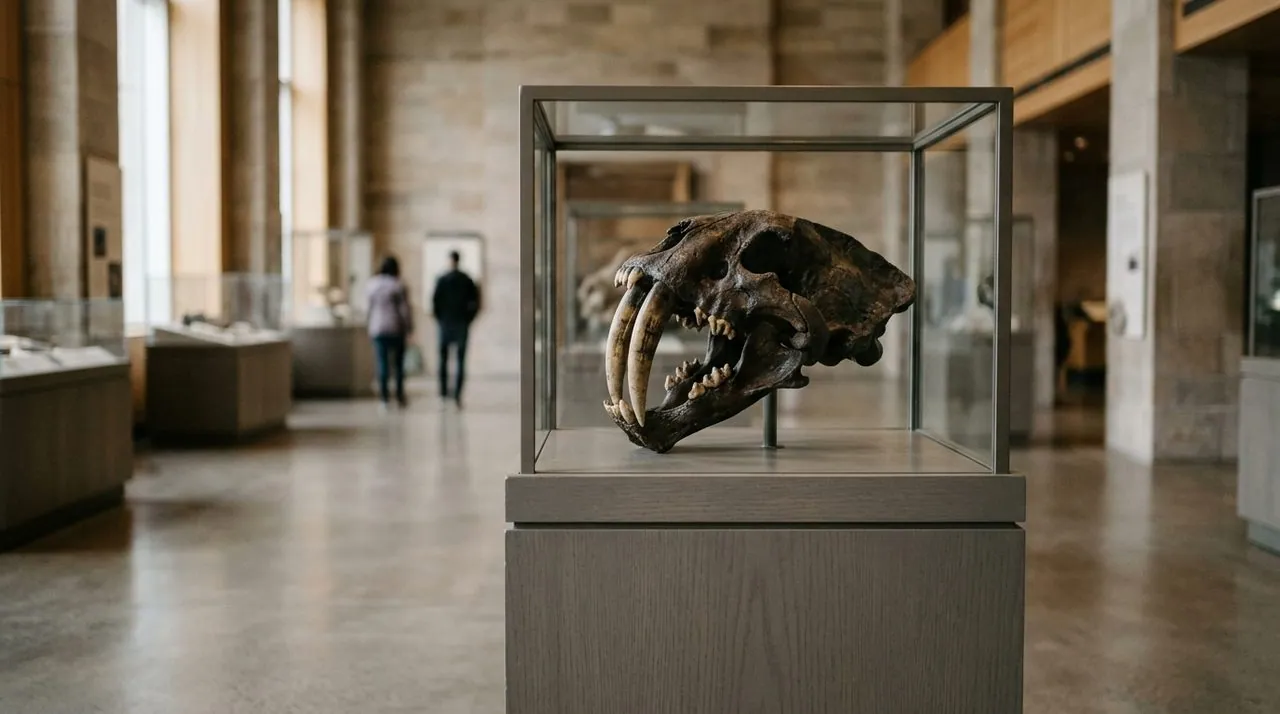
A newly described camel species that roamed North America 12 million years ago sported two sets of curved fangs, earning it the nickname "vampire camel." Paleontologists say the creature, named Vampyrocamelus, was actually a plant-eater, and its dramatic teeth were weapons for male combat. The species is one of five newly identified in a major study of North American camel evolution published in the New Mexico Museum of Natural History and Science Bulletins. The research reclassifies 80 species across 40 genuses and removes 130 previously identified species that are no longer considered valid.
"Unless you'd done something to make it mad, it wouldn't bother you at all," paleontologist Donald Prothero told CBC's As It Happens. "We just thought he deserved a sexy name." Prothero, an adjunct professor at California State Polytechnic University, Pomona, said only the males of the species had the large, curved fangs. The vampire camel lived between 12 and 13 million years ago in areas that are now Texas, Oklahoma and Nebraska.
Despite its fearsome dentition, molars recovered from fossils indicate it was an herbivore like all other camels. Prothero explained the fangs were used for fighting among males. "Male camels use their teeth to fight each other and bite each other until one of them dominates and then he gets to be the father of all the next generation," he said. He noted that while modern male camels also have more pronounced canines than females, they are more conical and much less obvious. "The males of modern camels use them to fight among themselves," Prothero said. "And I'm told that one of the things they do most often when they're fighting with their sharp teeth is to bite each other's testicles." The discovery sheds light on life during the Clarendonian period, when giant predators and herds of grazing mammals inhabited savannah-like grasslands in North America.
The research is based on analysis of the massive Frick collection at the American Museum of Natural History in New York, which contains about 200,000 specimens. Prothero said an entire floor of the collection is dedicated to camels, comprising 20,000 specimens. He described it as mostly drawers and drawers and drawers of skulls, jaws and limb bones. Some specimens have been in the collection for 100 years without being studied, he said. The collection was assembled by millionaire Childs Frick and was off-limits to outside scientists until after his death in 1965. It was moved to New York a decade later.
Prothero and his colleagues spent years categorizing the camel fossils. Among the five newly described species is a long-snouted camel called Longirostrotylopus holroydae. Danielle Fraser, a paleobiologist at the Canadian Museum of Nature who was not involved in the research, welcomed the new taxonomy. "If we don't know how many species there were, we may fail to reveal true patterns of evolutionary change," Fraser said in an email. "This monograph could help improve fossil databases that are used by numerous scientists to understand how mammalian faunas have changed through time." Prothero said camels first evolved in North America about 46 million years ago, and his mission since 1982 has been to document every camel species on the continent. Today's camels live in the deserts of Africa and Asia and the mountains of South America, but their ancestors were widespread across North America for millions of years.